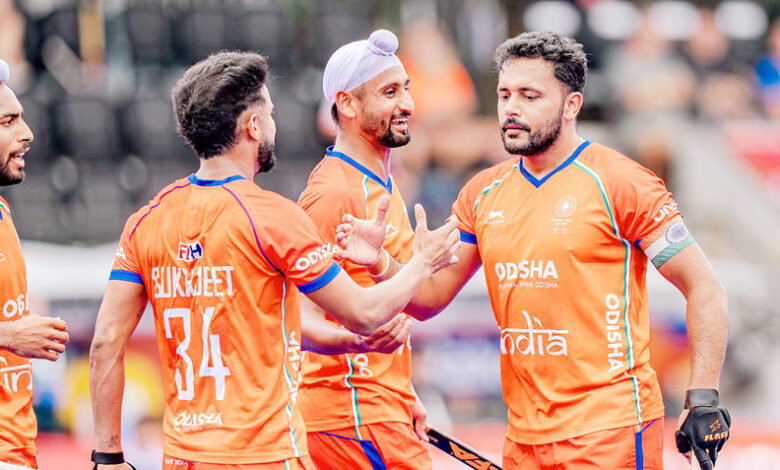
Amstelveen, Netherlands: India’s hopes of reaching the semi-finals of the FIH Men’s Hockey World Cup will hinge on two crucial second-stage matches against hosts the Netherlands and Argentina. Led by captain and drag-flick specialist Harmanpreet Singh, India will need victories in both games to keep its campaign on course for a place in the last four.
The Netherlands, meanwhile, enter the second stage in strong form after winning all three of their pool matches. The three-time world champions will also have home support behind them when they take on India at the Wagener Stadium on Saturday.

India and the Netherlands have already traded victories in the recent FIH Pro League. The Dutch side won the opening encounter 3-2, before India responded with a 3-2 victory in the return fixture. The closely fought contests underline the narrow margins expected when the two sides meet again.
India’s challenge will not be limited to creating scoring opportunities. The team will have to remain equally disciplined defensively against a Dutch side renowned for its fast counter-attacking hockey. India chief coach Craig Fulton has repeatedly stressed the importance of maintaining the team’s structure, but the upcoming contest is likely to test that discipline more severely than previous matches.
Harmanpreet has been one of the standout performers of the tournament so far. The Indian captain has scored five goals in three matches, making him the leading scorer at this stage. India also received a major boost from its 5-3 victory over Pakistan, with young forward Abhishek Nain scoring twice, Harmanpreet adding two goals and Hardik Singh contributing one.
However, India will need a collective defensive effort against the Netherlands. Harmanpreet, Amit Rohidas and Sumit will have important roles at the back, while the team will need to keep a close watch on Dutch attacking threats including captain Thierry Brinkman, forward Jip Janssen and drag-flick specialist Tjep Hoedemakers.
The Netherlands’ counter-attacking ability could make India’s transition play particularly important. Forwards Abhishek Nain, Sukhjeet Singh, Dilpreet Singh and Mandeep Singh will need to create scoring opportunities while also tracking back to support the midfield. Experienced midfielder Manpreet Singh, along with Hardik Singh, Rajinder Singh and Vivek Sagar Prasad, could play a key role in maintaining India’s balance between attack and defence.
Fulton Calls for Discipline and Clinical Finishing
Fulton said India’s second-place finish in Pool D earned the team a place among the top eight, but the next stage represents an entirely different challenge.
He acknowledged that India will begin the second stage without points carried forward, making every match critical. According to the coach, the team must combine aggressive attacking hockey with an equally strong defensive structure against the Olympic champions.
Fulton said India would approach the Netherlands as an underdog but insisted that the team has the ability to cause an upset if it remains disciplined and converts its opportunities.
He also stressed the importance of maintaining the structure throughout all four quarters and starting and finishing the match strongly.
The coach pointed to India’s 5-3 win over Pakistan as an example of the need for greater discipline. India had established a substantial advantage before allowing Pakistan to score three goals after gaining greater possession.

Fulton also defended his decision to rotate midfielders during the tournament. With India scheduled to play seven matches in the World Cup before the Asian Games approximately two weeks later, he said managing player workloads would be important. Yashdeep Siwach, Nilakanta Sharma and Vivek Sagar Prasad have been rotated across the first three matches to keep the squad fresh.
Harmanpreet Stresses 60-Minute Performance
Harmanpreet said India will face two very different opponents in the Netherlands and Argentina and will have to remain committed to its tactical plans for the entire duration of both matches.
“We have to play well for the full 60 minutes in both matches,” the captain said, stressing that even small mistakes could prove costly against two technically strong teams.
He highlighted the importance of intelligent play without the ball, particularly against the Netherlands’ counter-attacking style and Argentina’s zonal defensive system.
According to Harmanpreet, India must strengthen its defensive structure while also making smart decisions in possession. The forward line will be expected to create opportunities, while the midfield will have to ensure a steady supply of passes into the attacking third.
He also backed India’s goalkeepers, Suraj Karkera and Mohit H.S., saying goals conceded should be considered a collective responsibility rather than blamed solely on the goalkeeper.
Harmanpreet emphasised that the team has enough depth, with every player aware of his role. He said the rotation of midfielders was part of a broader strategy to utilise the squad effectively during a demanding tournament schedule.
Against Argentina, India is expected to encounter a more physical and structured opponent. Harmanpreet said India would need to use overhead passes intelligently to break through Argentina’s defensive organisation while ensuring that Hardik Singh and the midfielders continue to provide quality service to the forwards.
For now, however, India’s focus remains firmly on the Netherlands. A victory against the hosts would provide a major boost to the team’s semi-final ambitions, while another defeat would leave its path to the last four considerably more difficult.
With two must-win matches ahead, India’s campaign has reached a decisive stage where attacking efficiency, defensive discipline and tactical consistency could determine whether the team advances to the semi-finals or sees its World Cup journey end in the second stage.